Trees are ESSENTIAL TO LIFE ON EARTH
Trees are part of a complex vital network of living organisms that together support the earth’s biological processes and make life on earth possible. In a natural process called photosynthesis, trees remove harmful carbon dioxide from the air through their leaves, releasing life-enhancing oxygen and storing the carbon in their wood. Massive and ongoing deforestation is already disrupting this process and contributing to climate change and the loss of species, threatening our very existence on earth.Trees Communicate
TREES DO NOT STAND ALONE
Some trees are extraordinarily ancient. A Spruce in Dalarna Province in Sweden is 9,550 years old. Some trees are amazingly tall – the giant Sequoias in California can be over 115 metres. They may seem isolated in their grandeur but they are not.
More and more science is discovering that trees are connected to each other and the planet in every way. They use a symbiotic relationship between their roots and fungi to help their neighbours. They use the wind and the air to transfer pheromones (chemicals) carrying messages of warning about predators or disease. They help to create rainfall and are beneficial in the fight against climate change by capturing carbon from the atmosphere. In every way they are intimately connected to all life on the planet. They create the air we breathe. Trees have been around for 370 million years – far longer than humans (only 200,000 years). They have evolved a highly economical and co-operative way of living. They have much to teach us.
UNDERGROUND
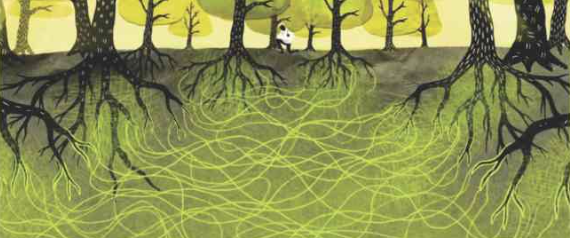
Much important activity goes on under your feet. The roots of trees spread out far wider than the canopy and are essential not only for stability but also because they have developed a co-operative relationship with ancient and widespread fungi (Mycelium).
In 1997 the theory of the "Wood-Wide Web" was first published in Nature. It has shown that fungi wrap themselves around and even penetrate the roots of trees and create an enormous system of filaments that spread throughout the forest floor.
This system can be 2,400 years old and extend over thousands of hectares. One teaspoon of forest soil can contain kilometres of fungal filaments. The result is a web of connectivity (not unlike our own internet) that carries nutrients and electrical signals (data) from tree to tree. The fungi take sugars (made of converted carbon dioxide) from the tree roots in return for extracting important mineral nutrients or carrying electrical messages. Trees use these pathways to communicate to other trees, not necessarily their own species. It seems they even "help" each other by sending nutrients to sick neighbours and support their offspring – young seedlings – which struggle to grow in the shady forest floor. When large, healthy trees in a forest are felled the survival rate of the young saplings drops immediately.
OVERGROUND
Trees communicate with each other by releasing pheromones (hormonal chemicals). The African Acacia, for example, warns neighbouring trees down-wind of the arrival of a giraffe or other herbivore. As its leaves are nibbled it sends out a gas which the other trees detect and which triggers them to pump a toxic chemical into their leaves to make them inedible to the predator. (Giraffes have learnt to combat this trick by going upwind as they graze, leaving a gap of 100 metres or so between the trees they browse).
In other species if a human damages the tree rather than an animal, the tree can detect the lack of any saliva from such an attack and sends a wound-healing chemical to the damage, rather than any warning signals. It seems that trees can taste!
WEATHER AND CLIMATE CONTROL
Trees have a marked effect on our weather. With large-scale deforestation rainfall can be reduced by up to 30%. This was demonstrated dramatically in Australia where more rain used to fall on the western side of the 750 km rabbit-proof fence until the trees there were felled and replaced with crops. Today there is significantly more rain on the eastern side.
With their carbon capturing processes (approximately 22 kg per year) trees are enormously important in tempering climate change. Through photosynthesis (tree "breathing") the tree draws in energy from sunlight converting the CO₂ into sugars to feed and grow itself, and trade with the underground fungi.
Trees release the remaining oxygen into the air – literally keeping us alive. It is estimated that the Amazon rainforest produces 20% of the oxygen in the earth's atmosphere. Two mature trees can produce enough for a family of four. Imagine what the 3 trillion trees that exist on the planet do.
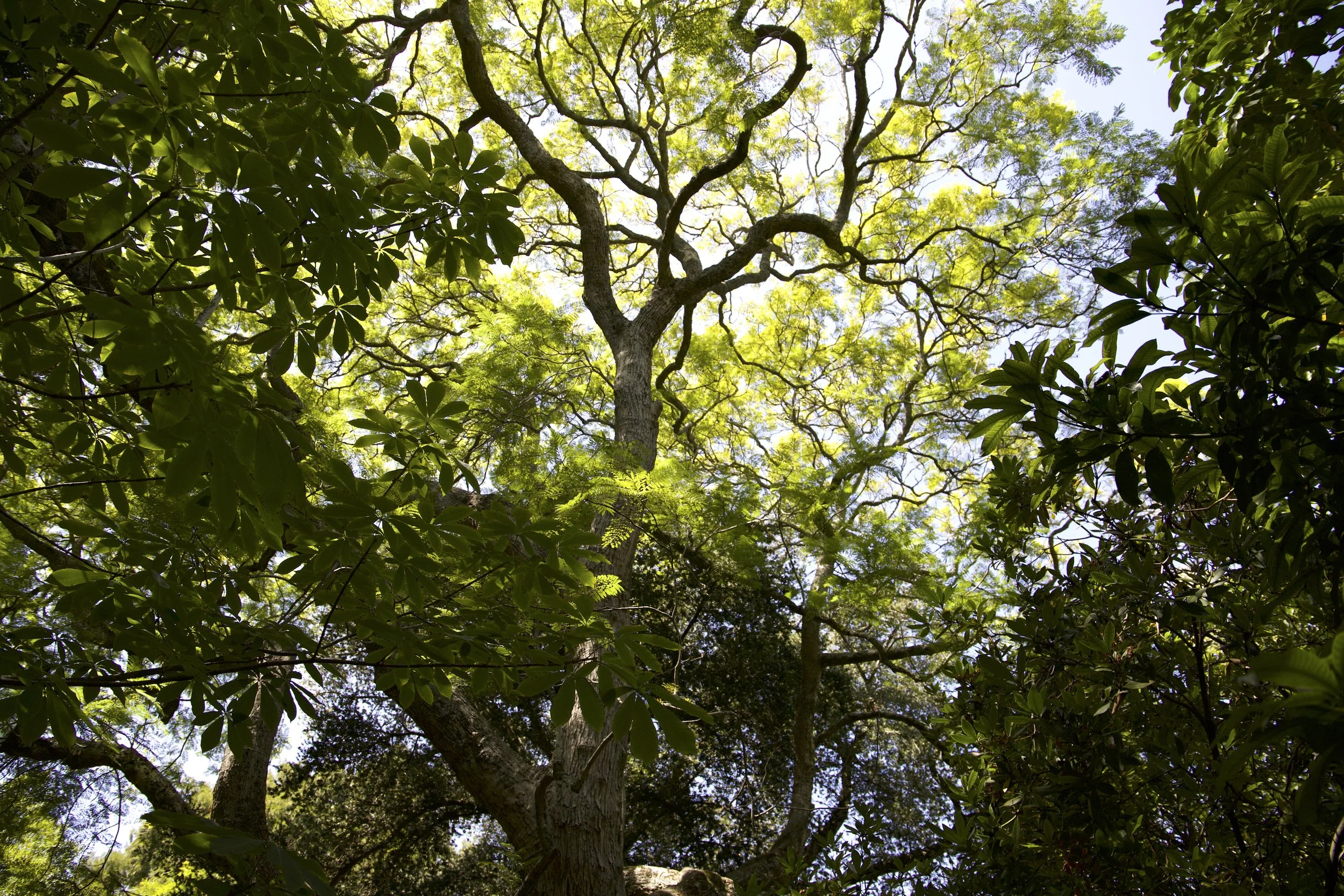
The trees in Arderne are all active in these ways. The fungus is transferring ‘data’ below your feet. Above ground the trees are aware of the dangers that surround them and are changing their chemical balances accordingly. Critically, they are pumping out the oxygen that keeps you alive and storing the CO₂ that we desperately need to remove from the atmosphere if we wish to protect future life on this planet, as we know it.
If you could attach a complex system of headphones to the branches of a tree in front of you, you would hear all this activity going on in the trunk. It roars.
A SPACE OF TRANQUILITY
They add a positive dimension to our mental and physical well-being. New research shows that, particularly for the growing urban populations, a minimum of two hours a week spent quietly in nature is measurably beneficial to our health. For children urban woodland and parks offer a chance to immerse in nature, listen to the birds, look at plants, collect leaves and seeds and enjoy adventuring outdoors.
A HOME FOR WILDLIFE
Trees are extraordinary havens for wildlife, offering refuge as well as habitat where seeds, fruit, lichens, rotting wood and fungi create a fertile environment able to sustain a diversity of life. Many trees become a veritable larder for birds and small creatures. At night, bats enjoy ripened fruit, whilst amongst the oaks, squirrels gather fallen acorns. Trees offer assorted perches for songbirds; roost sites for owls; blossoms for passing bees; and clusters of leaves for spring nests – all vital support for local wildlife.